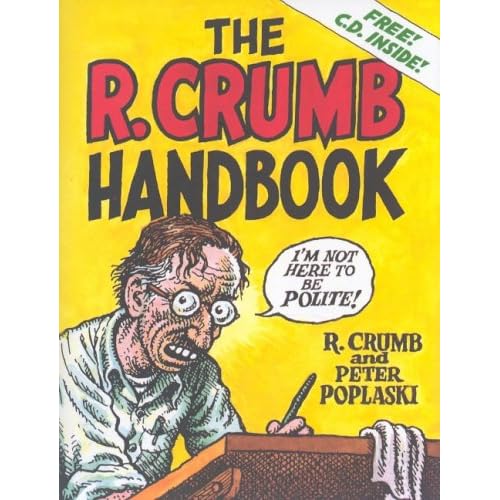
The R. Crumb Handbook
Category: Books,Comics & Graphic Novels,Graphic Novels
The R. Crumb Handbook Details
Amazon.com Review From the mountains of Southern France where he currently lives and works, pop artist R. Crumb makes a grand entrance back to the publishing world with The R. Crumb Handbook. Part biography, part comic book, and part media critique, the latest Crumb book is a feast indeed. In addition to numerous reprints of Crumb comic hits like Fritz the Cat and Mr. Natural, the book also features new works by Crumb, including a hilarious dialogue between the artist and his wife. (Both Crumb's wife and daughter are comic book artists.) Fans already familiar with Crumb’s comic book work will rejoice at the glossy reprints of Crumb oil paintings and sculptures, complete with gallery-owner narratives about working with the artist. There are also record covers reprints that Crumb has drawn over the years, as well as a CD of songs by the artist’s traditional band, R. Crumb and the Cheap Suit Serenaders. But more important, the Handbook helps provide a window into the man himself. In fact the more you read The R. Crumb Handbook the more you start to understand Crumb is really a political cartoonist, challenging stereotypes, cultural norms, and the media. U.S. media in particular has had a powerful and profound impact on Crumb. Readers will learn what TV shows and books inspired Crumb, the state of comics in the 1960s versus today, the media’s effect on day-to-day life, and what other comics served as models for Crumb in his own work. Artists like Jack Davis, John Stanley, Carl Barks, and the late Will Eisner made powerful impressions on Crumb about what comics could achieve. Crumb offers up some interesting insight into comics during the Great Depression (e.g., Dick Tracy and Superman) and explains how many of these comics mirrored the era and encouraged readers to "fight on" even during tough times. The R. Crumb Handbook is a solid piece of work, not only giving us a glimpse into the artist, but serving as a great read for old and new fans alike. --Pat Kearney Listen to an exclusive track from R. Crumb and the Cheap Suit Serenaders Read an interview with R. Crumb Exclusive Images from the R.Crumb HandbookSpoiler Alert: View at Your Own Risk! Build Your R. Crumb Library The Complete Crumb Comics Vol. 19 Complete Crumb Comics Your Vigor for Life Appalls Me: Robert Crumb Letters 1958-1977 The Life and Death of Fritz the Cat The R. Crumb Sketchbook Vol. 8: Early 1971 to Mid 1972 R. Crumb's Kafka Crumb in Other Universes Crumb (DVD) The Confessions of Robert Crumb (DVD) The R. Crumb Coffee Table Art Book Read more From Publishers Weekly Starred Review. Since the mid-'60s, cartoonist Crumb's artwork has been among the most recognizable in the annals of pop culture; his catalogue of characters like Mr. Natural and Fritz the Cat are as indelibly tied to their era as LSD and the Vietnam conflict. Crumb's true story is every bit as compelling a chronicle of his times as the provocative illustrations that emerged from his prolific pen. Many books have detailed his career, but this handsome volume is a must for the interested reader. It's a riveting autobiography that illuminates the artist's lifetime of foibles, sexual neuroses, cynicism regarding the spotlight of fame and his perceived status in the world of comics art, flavored with observations by several artists, writers and social theorists. The 400-plus pages fly by as the reader is dragged into the head of a troubled creative genius for an odyssey through a landscape of scabrous, politically incorrect caricatures of modern society that cast the bespectacled misfit in the reluctant role of a millennial Hogarth or Brueghel. Packed with photographs and some of Crumb's best known comics—including much explicit and inflammatory material—this is perhaps the most accessible and just plain fun of the multitude of Crumb histories. The book includes a CD of music by Crumb's bands, including the Cheap Suit Serenaders. (May) Copyright © Reed Business Information, a division of Reed Elsevier Inc. All rights reserved. Read more From Booklist *Starred Review* With Crumb's artwork readily available in the Complete Crumb series and two books of interviews with him (both entitled R. Crumb [BKL My 15 04]) out there, too, this chunky new volume may seem supererogatory. But it is so handsome and well produced (including a CD of selections from Crumb's sidereal career as an American old-timey and French bals musette musician) that it constitutes the ideal introduction to the influential cartoonist. The eight chapters, which read as if straight from the horse's mouth, are reflective and philosophical more than strictly autobiographical. As in the comics in which he portrays himself, Crumb tries to explain his life and art, and if he often trails off to "I dunno," his pessimistic skepticism sounds out loud and clear. The sixties sex-and-drugs revolution may have "liberated" him to portray his most embarrassing sex fantasies, but he doesn't think that sea change in mores was really all that good. His most perverse stories, some of which reappear here, contain the heat as well as the hilarity of satire. Besides those, a staggering wealth of his other art, dating from childhood to last year, and many photos, personal and public, occupy perhaps two-thirds of the pages. The text is almost typo-free, and the artwork reproductions are almost all immaculate, though those reduced from comic-book size make eye-challenging reading. Quite an accomplishment. Ray OlsonCopyright © American Library Association. All rights reserved Read more About the Author Robert Crumb is the only underground cartoonist to be recognized by the fine art world. Robert Crumb once proclaimed: "I’m not a Star! I’m just half a Star!" He is the creator of Fritz the Cat, Zap Comix, Mr Natural, Devil Girl and the Keep on Truckin’ Guys. He is the subject of two award-winning documentaries about his life and times. Robert hides in the South of France. Read more


Reviews
R. Crumb just may well be the most honest observer of the American scene of our generation. Since the mid-60s he's been looking at us and himself and putting his findings on paper. His eye has shifted focus several times over the past 50 years: early, cute satire; greeting card stuff that frequently was too risque to make it into print; the zapped LSD-inspired hippie drawings that made him the "father of underground comix"; the sexual confessions that earned him the hatred of some feminists and got him blacklisted from libraries (see the librarian's review of this book); the social critic who deplores consumerism, agri-industry, mass media, the ratrace, and the worship of the Almighty Buck; the music afficionado who writes incredible stories about his favorite musicians and musical genre; the philosopher who speculates about life, sex, fear, fame, and death; and always the autobiographer, who plumbs and probes and fingers his own psyche.The R. Crumb Handbook is the latest chronological/autobiographical compilation of his work. It's a good companion volume to The R. Crumb Coffee Table Art Book, which came out a decade ago. Crumb apparently doesn't like putting these things together, and does so only when he needs some cash (the Coffee Table Art Book paid for putting central heating in his French house). But both books are fine introductions to Crumb's work for those who've just discovered him, and nice walks down memory lane for those who are longtime fans. The artwork is punctuated by short Crumb essays, as well as a few appropriate quotes from folks like James Kunstler, C.G. Jung, and Charles Bukowski. The Crumb essays are interesting, but not as detailed as those found in the Coffee Table Art Book. But the Handbook includes the fantastic CD of music recorded over a period of 30 years by Crumb and his music palsBut there are some pleasant surprises in the hefty Handbook. There are several pages, for example, of "The Crumb Family," a strip co-authored by Crumb and Aline Crumb-Kominsky (pp. 218-229). It's absolutely hilarious, and exceedingly clever--which may be why the strip never made it to serialization. There are photos of Crumb-inspired tattoos--including one on a woman's firm tush--is it Aline's?--and of the life size statues of Devil Girl and Vulture Goddess Crumb sculpted in the 1990s. The Handbook also documents several European exhibitions of Crumb's work, including the one at the 1992 Angouleme comics Festival in France which featured a huge walk-in sized Crumb exploding head.For my money, though, the best of the latest stuff collected in the Handbook are the "philosophical reflections" on knowledge, personal identity, significance, and so on, with which Crumb filled his sketchbooks in the late 90s (pp. 370-390). They suggest a man who's beginning to feel his time running out and who wants to try to figure out a few things before the night closes in.One of the most touching--and revealing--illustrations in the Handbook is its final illustration in which Crumb lists the cartoonists and illustrators who've influenced him. At the very top of the list is his genius and tragic older brother, Charles Crumb, Jr.